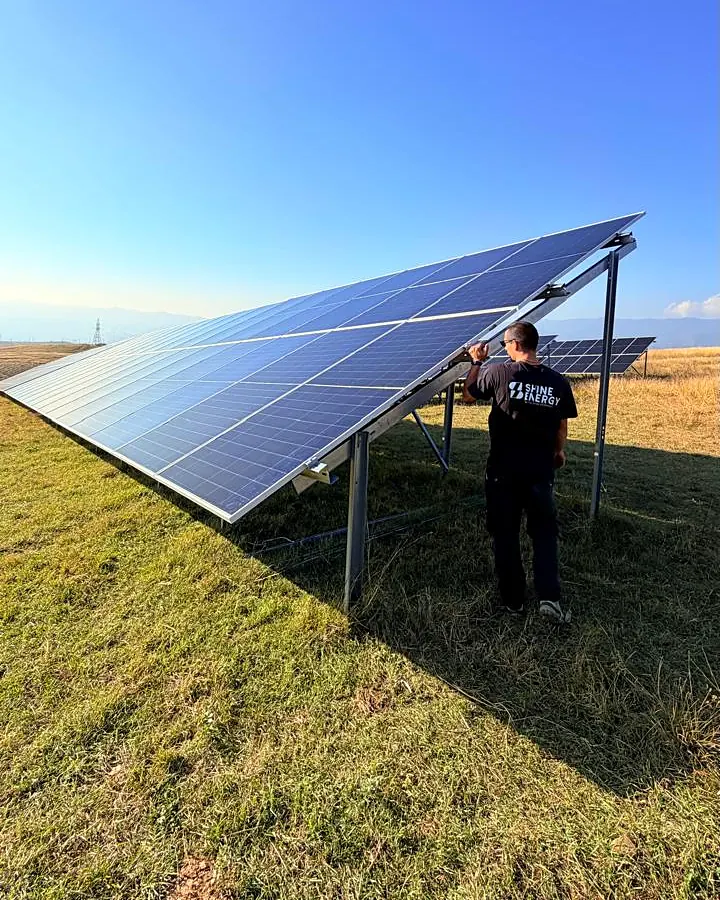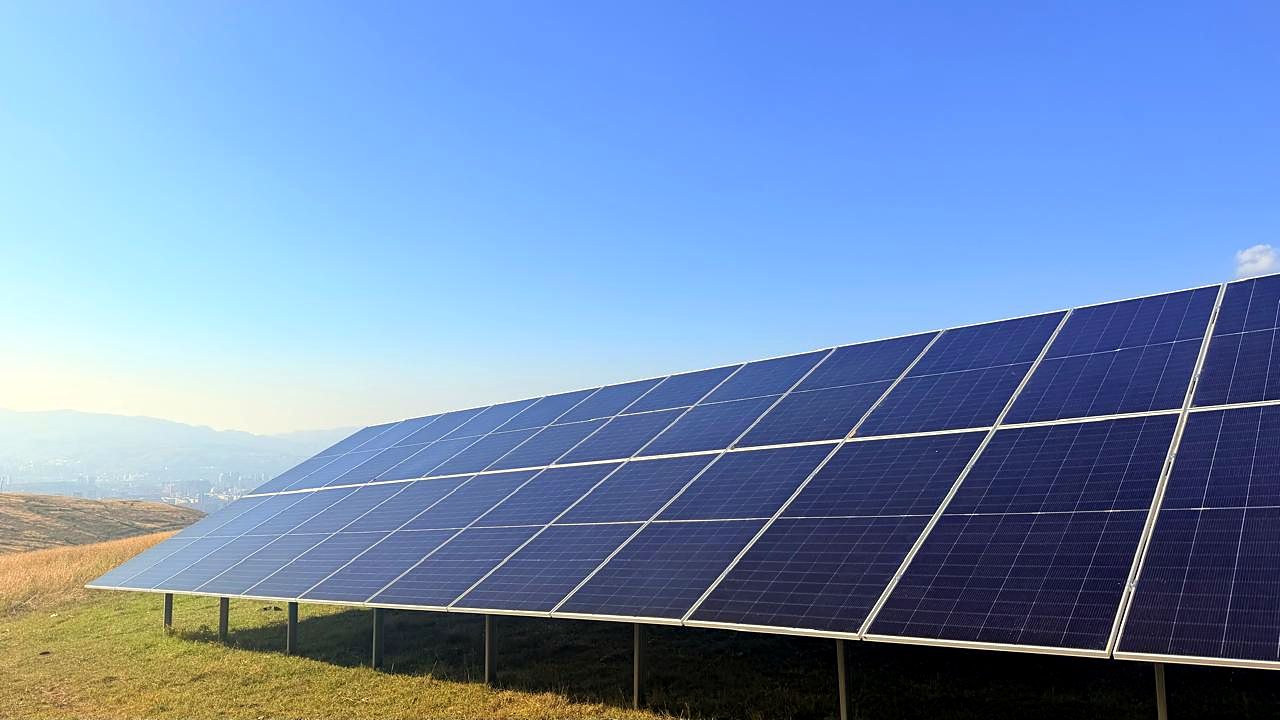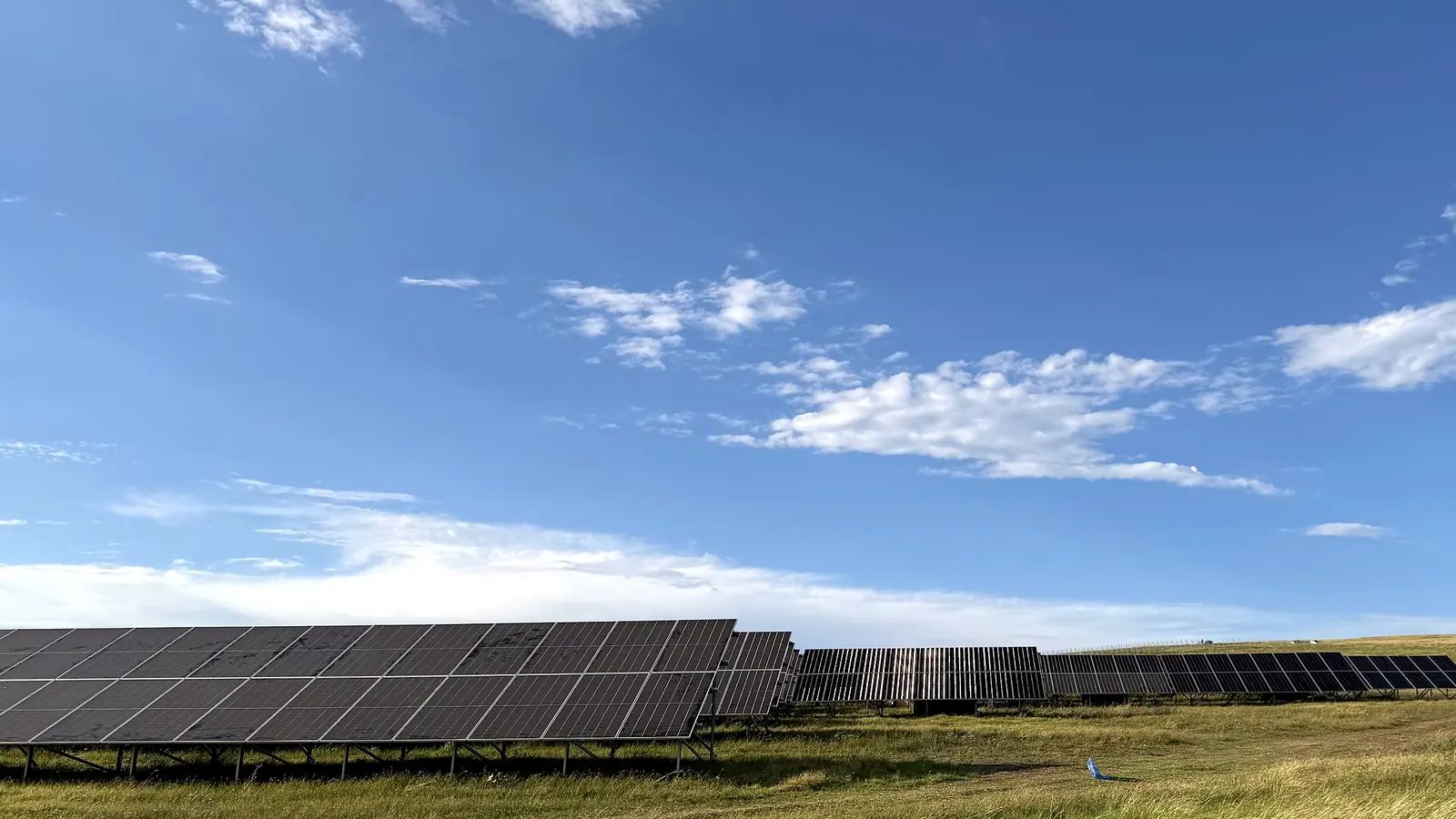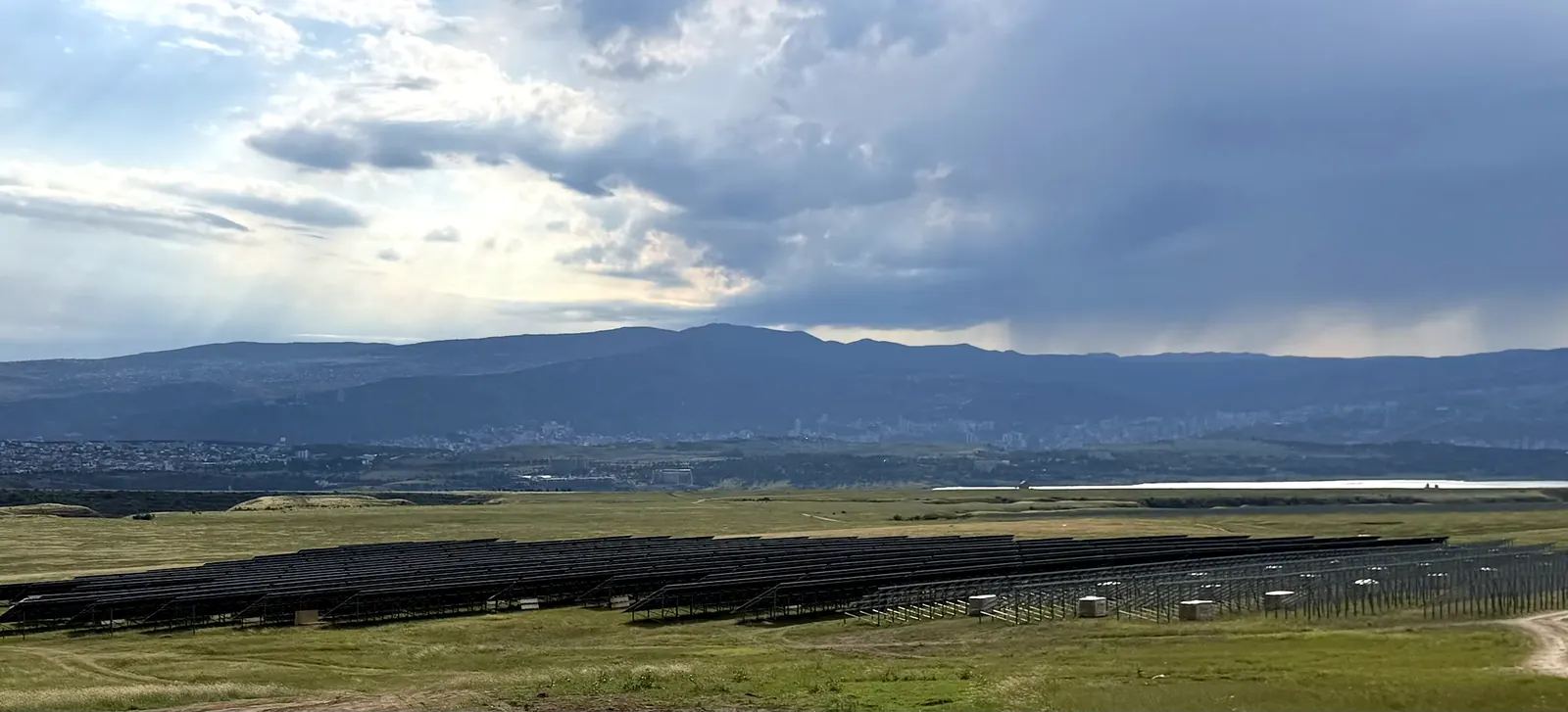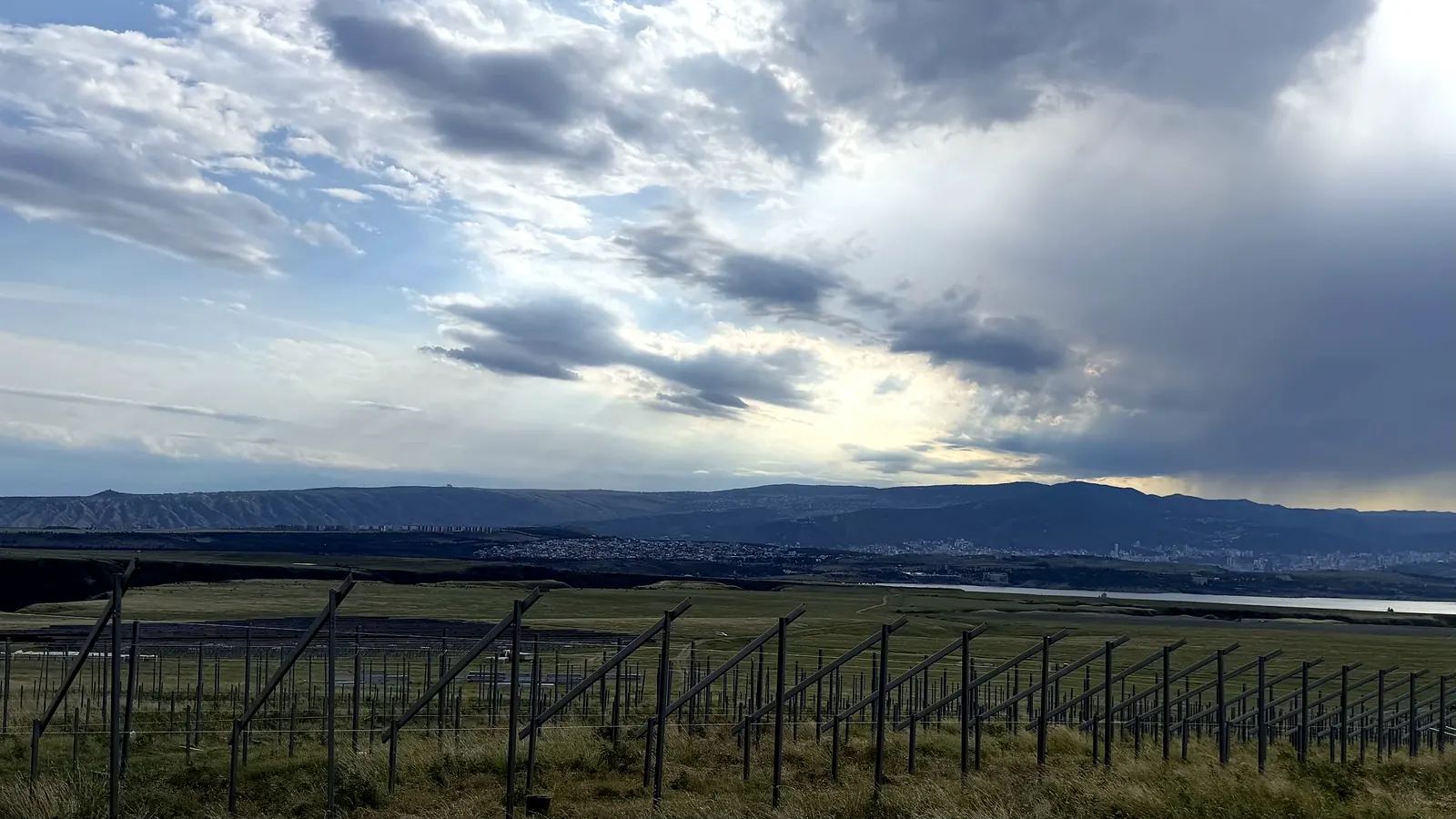
Developing a solar farm in Georgia takes six workstreams: site and land, grid connection, permits, a revenue contract, financing, and construction. None of them is unusually hard, but the order matters, and grid capacity is now the scarcest resource. This guide walks through each step for plants from 500 kW to about 50 MW, with the rules and numbers as of October 2026 and lessons from our own 2.5 MW plant in Tbilisi.
Solar farm development in Georgia at a glance
| Step | What decides it | Key facts |
|---|---|---|
| 1. Site and land | Irradiation, land title and category, distance to grid | About 1 ha per MW; about 1,250–1,400 kWh per kWp a year in the east (PVGIS), more for well-built plants |
| 2. Grid connection | Capacity at the nearest substation | GSE caps new solar at 0.5 GW (source) |
| 3. Permits | Environmental screening, construction permit, licence | GNERC licence only above 15 MW |
| 4. Revenue | Net metering, CfD, PPA or market | CfD: 15 years, all 12 months for solar |
| 5. Financing | Bankable revenue and documents | EBRD and Georgian banks lend to solar |
| 6. Build and operate | EPC contract, independent engineer, O&M | EPC about $300 per kWp at MW scale |
Step 1: Site and land
Irradiation. Eastern and central Georgia are the sunniest parts of the country. The EU's PVGIS model gives about 1,300–1,350 kWh per kWp a year for a standard fixed-tilt plant around Tbilisi, Rustavi, Sagarejo and Gori, against about 1,100–1,220 on the Black Sea coast (yield by city). Well-built plants do better: Udabno in Kakheti reports about 1,560 kWh per kWp (source). Check any site in the EU's PVGIS tool, then commission a bankable P50/P90 yield study.
Area. Plan on about 1 hectare per MW including row spacing. Flat or gently south-facing land with road access keeps construction costs down.
Land title and category. Order a fresh Public Registry extract, check boundaries on the ground and look for leases, mortgages or disputes. Much of the suitable land is classified as agricultural. Foreign individuals cannot own agricultural land in Georgia; ownership through a Georgian company is common, but the structure should be checked by a lawyer before you sign (source). A long-term lease is often the simpler route.
Price. Land near cities is expensive: at Mukhiani One, land was 36% of the budget. Cheaper land further out usually means a longer connection line.
Step 2: Grid connection
Grid capacity is now the tightest constraint. GSE, the transmission operator, has limited how much new solar the grid can absorb to 0.5 GW (source), and its ten-year plan lists 31 solar plants for possible commissioning in 2026, 23 of them in Kakheti (source).
- Up to 500 kW: connect to the distribution network (Telasi in Tbilisi, Energo-Pro Georgia in most regions), usually under the net metering rules.
- Larger plants: small plants usually connect to the distribution network at medium voltage; plants of tens of MW usually connect to GSE's high-voltage network. The developer normally builds the line and substation bay.
- Get the connection offer early. It sets the capacity, the route, the cost and the date. At Mukhiani One the connection cost about $66,000 per 500 kW plant, and the connection, not construction, set the start of operations.
Step 3: Permits and licences
- Environmental assessment. Solar PV is not named in the annexes of the Environmental Assessment Code, which list the projects that need a full EIA or screening. Confirm the position early with the environmental authorities, especially for large ground-mounted plants or sensitive sites. See our power plant permits guide.
- Construction permit. Required for every plant and usually staged: site use conditions, design, then the permit. Large energy facilities are usually permitted nationally, smaller ones by the municipality.
- Generation licence. Plants up to 15 MW only notify GNERC; larger plants need a generation licence. Net-metering plants up to 500 kW need neither.
Step 4: Choose how to sell the electricity
| Route | Who it suits | How it works |
|---|---|---|
| Net metering | Plants up to 500 kW | Output is offset against the consumption of the owner or a group of users. Plants connected before 1 January 2027 keep it until 2033; new plants move to net billing (guide) |
| CfD (state support) | Plants above 0.5 MW | Two-way contract for difference with ESCO for 15 years; solar is supported all 12 months of the year (source) |
| Bilateral PPA | Plants with a strong corporate buyer | Direct contract with a trader or large consumer; tenor and currency are negotiated |
| Merchant | Investors comfortable with price risk | Sell on the day-ahead market run by GENEX since July 2024 (source) |
How the CfD works for solar. Plants above 0.5 MW can win support in a capacity auction or, since amendments in June 2024, through direct selection by the Ministry of Economy (source). The plant sells its power in the market, and ESCO pays or receives the difference against the agreed tariff. In the direct-selection window that ran from September to December 2024, the fixed tariff for solar was 5.6 US cents per kWh. Selected projects sign a feasibility agreement and then an implementation agreement with the government, and post a pre-construction guarantee of $20,000 per MW and a construction guarantee of $40,000 per MW (source). The second auction reserved capacity for solar with storage (source). Check the Ministry for the current round before you plan around a tariff; see also our guide to the electricity market and CfD auctions.
Step 5: Costs and financing
- EPC. At megawatt scale, turnkey EPC prices in Georgia are around $300 per kWp; that is what Mukhiani One paid. See our solar price guide for smaller systems.
- All-in cost. Add land, grid connection, development and financing costs. Mukhiani One came to about $630 per kWp all-in, with expensive land near Tbilisi; the 6.4 MWp Udabno plant in Kakheti was reported at about $2.7 million (source).
- Lenders. The EBRD approved up to $19.6 million for the 52.8 MW Veli solar portfolio in 2026 (source), and Georgian banks such as TBC Bank finance plants from 500 kW upwards. Lenders will want a clear land title, the connection agreement, permits, a revenue contract and an independent yield study.
Step 6: Build and operate
- EPC contract. Fix the price, the completion date with delay penalties, a performance ratio guarantee and warranties for modules and inverters.
- Independent engineer. Lenders usually require one to review design, construction and commissioning.
- Operations. Cleaning, maintenance and monitoring are cheap: Mukhiani One's first-year operating budget is about $18,000 for 2.5 MW. Track output against the P50 case from day one.
Critical path and common mistakes
- Building before the grid is secured. A finished plant earns nothing until it is connected.
- Signing land before checking title and category. Fixing a title problem later costs months.
- Assuming a tariff that has changed. Support windows and rules change; base the model on the current round and contract.
- Ignoring the 2027 deadline for small plants. Plants up to 500 kW connected after 1 January 2027 lose net metering.
- Thin yield data. Lenders discount projects without a bankable P50/P90 study.
Work with us
We develop solar in Georgia with our own capital and advise investors on the same steps: site screening, grid, permits, revenue contracts and financing. See our solar advisory and co-development services or get in touch.