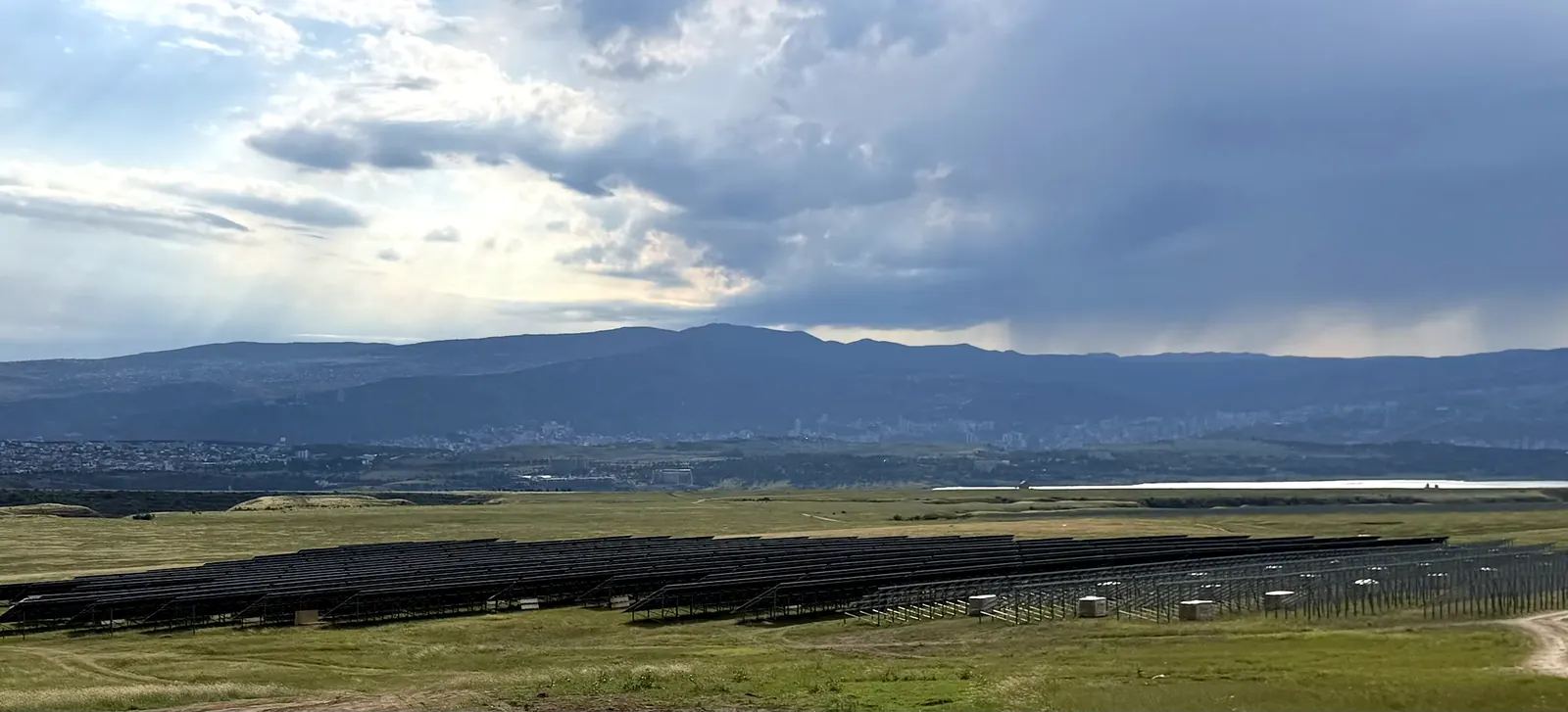
Net metering lets the owner of a small solar plant in Georgia offset the electricity it exports against the electricity it uses, kWh for kWh. It is the reason most rooftop and commercial solar in the country pays back quickly. The rules change on 1 January 2027, when new plants move to monthly net billing. This guide explains how net metering works, who can use it, how to connect, and what the 2027 switch means for owners and investors. Rules are as of October 2026.
What is net metering in Georgia?
GNERC defines net metering (ნეტო აღრიცხვა) as two-way metering of the electricity a micro power plant sends to the grid and the electricity taken from it, so that one offsets the other (source). Exported power becomes a credit on the next bill; at the end of the settlement year (May to May), any credit left over is bought by the distribution company.
| Rule | Net metering today |
|---|---|
| Maximum size | 500 kW per micro power plant |
| Technologies | Solar, wind, hydro and other renewables |
| Who can use it | Any individual or company, homeowners' associations, residents of a neighbourhood or village |
| Ownership | The plant can be owned, leased or held under another contract |
| Location | Generation and consumption can be at different sites on the same distribution network |
| Settlement | Monthly credits, annual true-up from May to May |
| Price for surplus | Average day-ahead market price set by GNERC |
| Licence | No GNERC generation licence; using net metering is not treated as an entrepreneurial activity |
Group and remote net metering
Two features make net metering useful for larger projects:
- Remote sites. The plant and the consumer do not need to be in the same place, as long as both are connected to the same distribution company: Telasi in Tbilisi, or Energo-Pro Georgia in most regions.
- Groups of consumers. One plant can serve a group of consumers. Each member gets an individual two-way or smart meter, and the plant's output is split equally among them unless they agree otherwise (source).
This is how a 500 kW plant on cheaper land can supply businesses elsewhere in the city. Our own Mukhiani One project uses five 500 kW plants in Tbilisi to supply private companies this way.
How to connect a micro power plant
- Apply to the distribution company (Telasi or Energo-Pro Georgia), or through a Public Service Hall.
- Pay 50% of the connection fee set by GNERC before you submit; the rest is due within 5 days of completion.
- Completeness check. The company has 10 working days to confirm the application is complete or flag gaps.
- Technical inspection. Before switching on, the company checks the connection scheme and automatic controls, and installs a two-way or smart meter.
Limits and quotas
Distribution networks can only take so much microgeneration. In February 2025 GNERC kept the 500 kW cap for Energo-Pro Georgia's network and raised the share of network load that microgeneration may use to 20% (source). By February 2025, 1,805 micro plants were connected: 465 on Telasi's network and 1,340 on Energo-Pro's (source). Installers report that quotas are largely used up in Energo-Pro areas, while some Tbilisi sites can still connect (source). Check capacity at your substation before you commit.
The 2027 switch: from net metering to net billing
| Connected before 1 January 2027 | Connected from 1 January 2027 | |
|---|---|---|
| Scheme | Net metering (annual netting) | Net billing (ნეტო დარიცხვა), settled monthly |
| How exports are valued | Offset kWh for kWh against your own consumption | Paid in money at a rate set by GNERC |
| How long | Until 1 January 2033 | Ongoing |
| Fees | Current exemptions continue | Systems under 100 kW lose the exemption from system and market service fees |
Sources: GNERC via BPN (source) and EBRD GEFF (source). GNERC says the switch follows Georgia's commitments under the EU Association Agreement and the Energy Community.
The difference in value is large. Under net metering, each exported kWh offsets a kWh a business would otherwise buy at about 35 tetri. Under net billing, exported power is paid at roughly the wholesale price, about 6–10 tetri per kWh (source).
What this means for owners and investors
- The deadline is the connection, not the build. Only plants connected before 1 January 2027 keep net metering until 2033. Construction can be quick; the distribution company's connection is often the slow step.
- Model two periods. For plants connected in time, use the net-metering value until 2033 and a lower, market-based value after that.
- Size new systems to daytime use. From 2027, a kWh you consume yourself will be worth three to six times more than a kWh you export. See our solar panel price and payback guide.
- Group structures still work. Remote and group consumption lets one plant serve several businesses, which is useful when the best land is not next to the buyers.
Planning a 500 kW plant or a portfolio? We have built one ourselves; see our solar advisory and co-development services or get in touch.