Georgia is replacing the model that built its private hydropower sector, long-term guaranteed power purchase agreements (PPAs) with a state buyer, with an exchange-based electricity market and competitive auctions for contracts for difference (CfDs). For generators, lenders and buyers of power plants, this changes how revenue is earned, who carries price and balancing risk, and how assets should be valued. This guide explains the new market, how Georgia's CfD works and what investors should check. Information is as of October 2026.
Georgia's electricity market reform at a glance
| Item | Status |
|---|---|
| Legal basis | Law on Energy and Water Supply (2019), aligned with the EU Third Energy Package (source) |
| Exchange trading | Transitional model since 1 July 2024: hourly day-ahead and intraday markets on GENEX, alongside the existing balancing electricity model (source) |
| Intraday market | Suspended from 1 October 2026 to 1 July 2027; day-ahead trading continues (source) |
| Renewable support | Two-way CfD with ESCO, introduced in December 2022 (source) |
| CfD term | 15 years from commissioning, covering 8–12 months a year depending on the technology (source) |
| Auctions held | 2023: 300 MW offered, 943 MW bid, 27 winners. 2024: 800 MW offered, 1,877 MW bid (source, source) |
From guaranteed PPAs to a market
Since 2007, Georgia supported new plants mainly through guaranteed PPAs with ESCO, the state electricity market operator. Under that incentive, 83 power plants with 1.4 GW of capacity were built; the PPA mechanism was suspended between 2017 and 2021 (source). The PPA model gave developers bankable revenue, but it concentrated risk with the state and offered little price discovery.
The reformed market has four segments:
- Day-ahead market (GENEX): participants submit hourly buy and sell orders for the next day; a clearing price is set for each hour.
- Intraday market (GENEX): adjustments closer to real time; currently suspended until July 2027.
- Balancing: GSE, the transmission system operator, keeps the system in balance; participants pay for deviations from their schedules.
- Bilateral contracts: direct deals between generators, suppliers and large consumers.
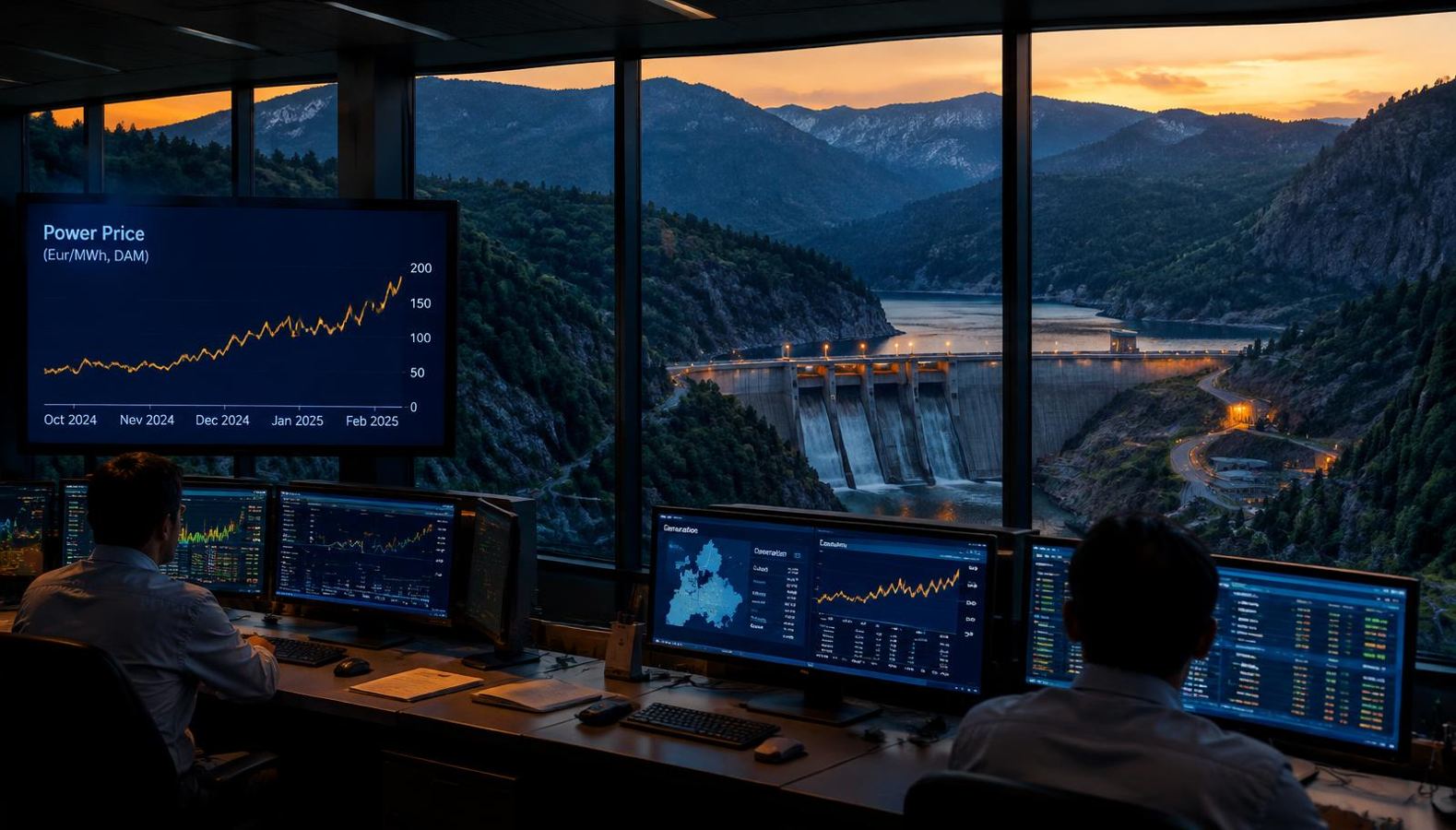
Liquidity was thin at the start. On the first trading day (for delivery on 2 July 2024), four participants were registered and no trades cleared: in the 18:00–19:00 hour, sellers asked 140.51 GEL/MWh while buyers would pay at most 122.75 GEL/MWh (source). Exchange prices are now published daily, which gives investors something Georgia never had before: an observable reference price.
How Georgia's CfD works
Georgia introduced CfDs as its renewable support mechanism in December 2022 (source):
- Auction. The Ministry of Economy sets capacity quotas by technology. Bidders offer a target (strike) price, and capacity is allocated starting from the lowest bids (source).
- Contract. Winners sign a contract with ESCO, the 100% state-owned market operator.
- Settlement. The plant sells its power in the market. If the day-ahead price is below the strike price, ESCO pays the difference; if it is above, the producer pays the difference back to ESCO. Before the day-ahead market existed, the balancing electricity price was used (source).
- Term. Support lasts 15 years from commissioning, for 8–12 months a year depending on the technology (source).
The second auction showed how the state wants the system to develop (source):
| Category | Capacity offered |
|---|---|
| Regulating hydropower (with storage reservoirs) | 300 MW |
| Other hydropower | 100 MW |
| Wind | 125 MW |
| Solar | 125 MW |
| Wind with energy storage | 70 MW |
| Solar with energy storage | 70 MW |
| Other renewable sources | 10 MW |
The focus on regulating hydropower and storage reflects Georgia's real problem: a summer surplus and a winter deficit. For how solar projects use the CfD in practice, including direct selection and the guarantees involved, see our solar farm development guide.
What to check in a CfD award
- Strike price and currency: what is fixed, and in which currency; revenue in lari against dollar or euro debt is a key risk.
- Reference price: hourly day-ahead price, and what happens in hours with no clearing price.
- Covered months and volumes: which months are supported and whether output outside them is fully merchant.
- Tenor against debt: 15 years of support must cover the loan term with headroom.
- Counterparty and payment security: ESCO's obligations, payment timing and remedies.
- Change in law and termination: compensation if the support framework changes.
- Milestones: construction deadlines and penalties for late commissioning.

Financing and balancing costs
Lenders such as the EBRD, ADB and IFC sized loans on fixed PPA cash flows in the past. Under a CfD-plus-market model, they usually apply a lower debt service coverage ratio to supported revenue and a higher one to merchant revenue, and they run low-price, low-hydrology and imbalance-cost cases before approving a loan.
Balance responsibility is a new, recurring cost for variable plants. Ways to reduce it:
- Invest in good generation forecasting.
- Join a balance group or hire a route-to-market provider.
- Add storage or flexible capacity to reduce deviations.
What the reform means for existing plants
If you own or plan to buy an operating plant:
- Legacy PPA expiry: when the PPA ends, revenue moves to the market. Value the plant on realised seasonal prices, not the old tariff.
- Seasonality: hydro produces most when prices are lowest; check winter output, which earns more.
- Exports: summer surplus can be sold to neighbouring markets; check transmission access and costs.
- Readiness: hourly metering, scheduling and settlement systems.
See our guide to buying a hydropower plant in Georgia and our hydropower risk framework.
Who does what
| Institution | Role in the market |
|---|---|
| Ministry of Economy and Sustainable Development | Energy policy, design of support schemes, CfD auctions |
| GNERC | Regulator: licences, tariffs, market rules (source) |
| GSE | Transmission system operator, dispatch and balancing |
| ESCO | Market operator, CfD counterparty and buyer under legacy PPAs |
| GENEX | Georgian Energy Exchange: day-ahead and intraday markets |
For more on the regulator, see GNERC explained.
Checklist for sponsors and buyers
- Build an hourly revenue model that separates CfD, bilateral and merchant volumes.
- Model imbalance costs explicitly, not as a percentage haircut.
- Test the currency mismatch between lari revenue and hard-currency debt.
- Review change-in-law protections in the support contract.
- Ask lenders early how they treat merchant revenue.
- Validate hydrology or wind and solar resource data independently.
- Assess export options for low-price months.
Caucasus Energy Partners supports investors with regulatory advice, revenue model reviews and transaction structuring. See also our articles on wind power plants and solar energy in Georgia.
Bidding in an auction or buying a plant with market exposure? Contact us.
This article is general information, not legal, financial or investment advice. Market rules change; check current regulations with qualified advisers.