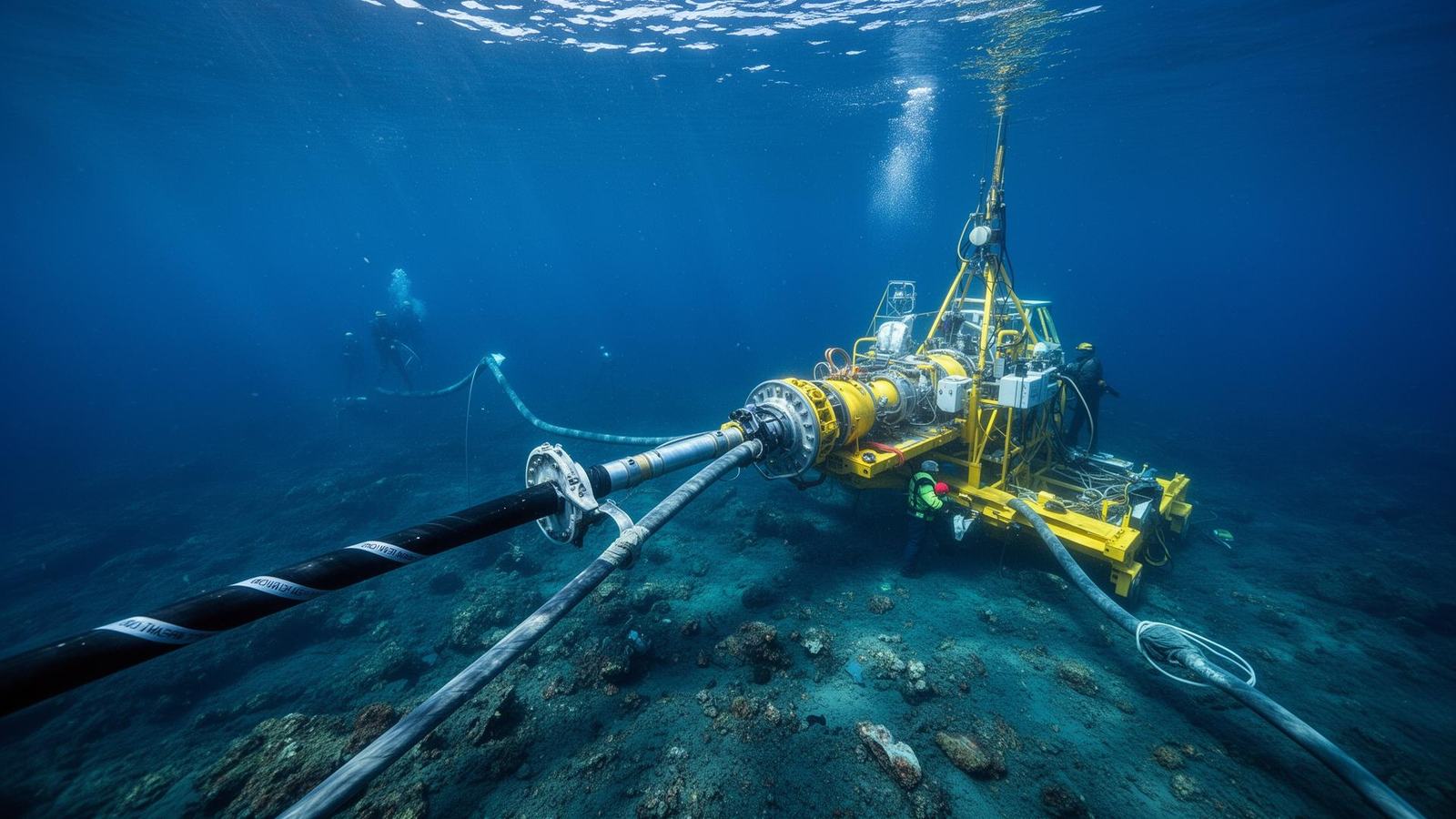
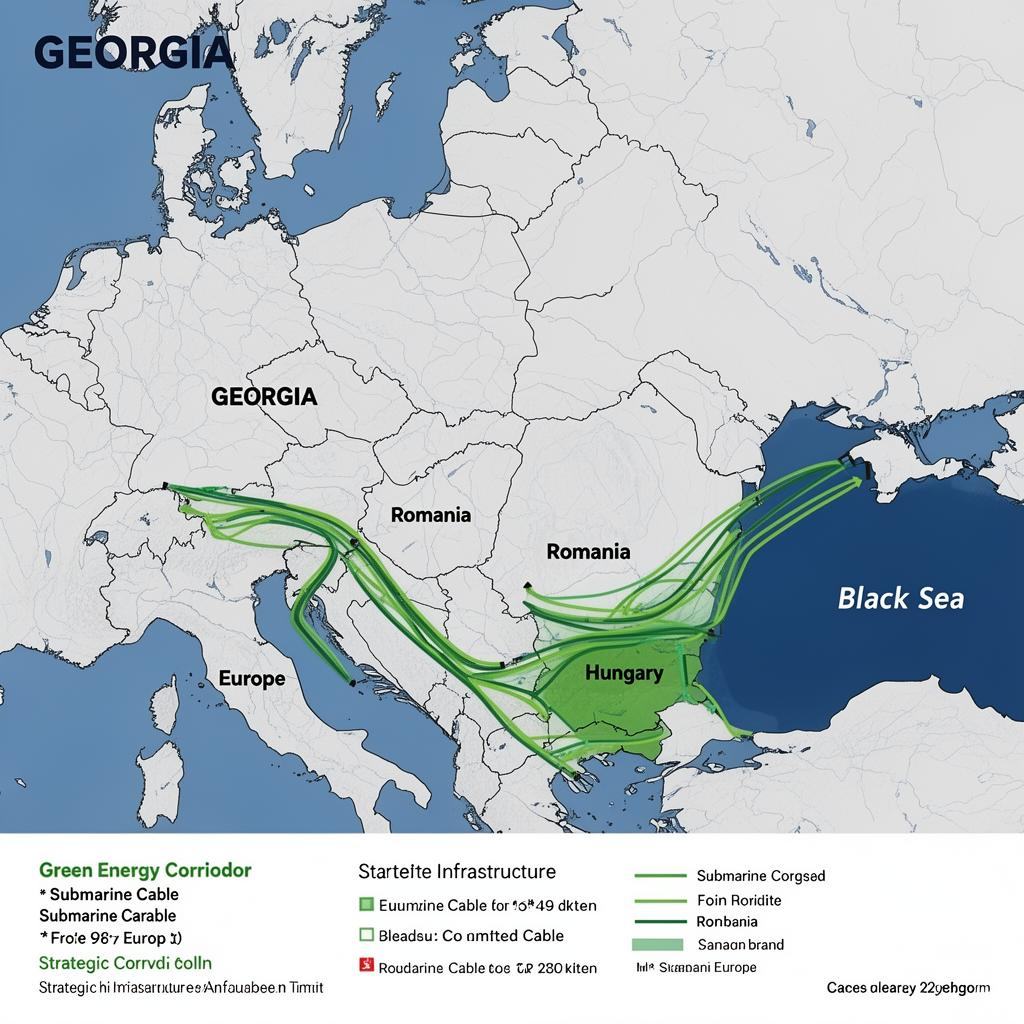
The Black Sea Submarine Cable would be the first direct power link between the South Caucasus and the European Union: a high-voltage direct current (HVDC) cable of about 1,155 km from Anaklia in Georgia to Romania. If built, it would also be the longest submarine power cable in the world. This guide sets out the project's specifications, who is behind it, where it stands in 2026 and what it could and could not mean for energy investors in Georgia. Information is as of October 2026.
Key facts
| Item | Detail |
|---|---|
| Route | Anaklia (Georgia) to Topraisar near Constanța (Romania) (source) |
| Length | About 1,155 km, of which about 1,115 km under the sea and 40 km on land (source) |
| Technology and capacity | HVDC, ±525 kV, 1,300 MW, with a fibre-optic cable in the same corridor (source) |
| Water depth | Some sections deeper than 2,500 m (source) |
| Estimated cost | About EUR 2.3 billion (source) |
| Developer | GECO Power Company, a joint venture of the grid operators of Azerbaijan, Georgia, Romania and Hungary with equal shares (source) |
| Target completion | 2030, as stated by GSE in February 2025 (source) |
| Status | Preparation: seabed survey and updated feasibility study; no final investment decision yet (source) |
Who is behind the project
- December 2022: the governments of Azerbaijan, Georgia, Romania and Hungary signed a strategic partnership agreement on green energy development and transmission (source).
- July 2023: the four governments signed a memorandum on setting up a joint venture.
- September 2024: the grid operators AzerEnerji, GSE, MVM and Transelectrica founded GECO Power Company; it was registered in Bucharest in early 2025 (source).
- May 2024: the World Bank approved a USD 35 million loan for preparation, under a programme that could reach USD 500 million (source).
- December 2025: the project was added to the EU's list of Projects of Mutual Interest (source).
- 2026: Transelectrica and GSE signed a memorandum on studies and surveys; CESI was hired to design and supervise the seabed surveys; Georgia's 2026 budget includes GEL 25 million for survey work (source).
Where the project stands in 2026
In July 2026, Transelectrica hosted a workshop with GSE and CESI on the seabed study, the cable route, permits for the Romanian section, the schedule and costs. Current work focuses on preparing the marine survey and updating the feasibility study, together with economic, financial and regulatory analysis. Romania is also assessing the grid investments needed to absorb 1,300 MW near Constanța (source).
The memorandum between the two grid operators supports development but is not a final investment decision (source). Older timelines that showed construction from 2025 and operation in 2029 should be treated as out of date.
What the cable means for Georgia's power system
- Exports in summer. Georgia's hydro system produces a surplus in spring and summer. A link to the EU market could raise the value of that surplus, depending on prices and how cable capacity is allocated.
- Imports in winter. The same link could help cover winter deficits.
- Azerbaijani renewables in transit. A main purpose of the corridor is to carry Azerbaijani wind and solar power through Georgia to Europe (source), which also requires stronger lines across Georgia.
- Domestic grid upgrades. A converter station at Anaklia and reinforcement of the western Georgian grid are part of the wider programme; see our guide to Georgia's power grid.
What it means for investors
Opportunities:
- Generation that can export in summer could earn more if cable capacity is available to Georgian producers.
- Flexible assets, such as batteries and regulating hydropower, gain value as the system becomes more connected.
- Engineering, construction and services contracts for grid reinforcement in Georgia.
Cautions:
- No guaranteed export access. Capacity allocation rules, prices and access for Georgian generators are not yet defined.
- Timing risk. The project is at the survey and feasibility stage; do not build a project's base case on cable revenue.
- Grid limits today. Until reinforcements are built, GSE's limits on new wind (0.75 GW) and solar (0.5 GW) capacity still apply (source).
The sound approach is to value Georgian projects on domestic market and CfD revenue, and treat exports via the cable as upside. See our guides to the electricity market and CfD auctions and cross-border electricity trading.
Assessing a project with export potential? Contact us for regulatory and transaction advice.